Table of Contents
You know the post the second you see it in the grid. Right words, right structure, wrong voice, it just doesn’t sound like your brand.
Maybe it’s a little too formal for an account that’s usually playful. Maybe it’s missing the one-liner humor your audience actually engages with. Whatever it is, followers who’ve been around a while can feel it too, even if they can’t name what changed.
That’s the real risk with AI social media content — not that it’s obviously robotic, but that it drifts. One post is close enough. Ten posts later, the account sounds like a slightly different brand than the one people followed.
Keeping AI for social media content on-brand isn’t about writing better prompts each time. It’s about giving the model something specific to sound like, instead of asking it to guess.
Why AI For Social Media Posts Drift From Your Brand Voice
An AI tool has no idea what your brand actually sounds like unless you tell it — and “write this in a friendly, professional tone” doesn’t tell it much. Every brand thinks of itself as friendly and professional. That instruction narrows almost nothing.
Without real examples to draw from, the model falls back on the same generic patterns it uses for everyone else’s captions: safe, polished, and interchangeable with a hundred other brand accounts.
The drift isn’t a flaw in the tool. It’s what happens by default when brand voice isn’t part of the input at all.
Build a Brand Voice Reference Before You Write Anything
Before generating a single caption, write down what your brand voice actually is — three or four specific traits, not vague adjectives. “Warm, a little sarcastic, never uses exclamation points, always addresses the reader directly” tells an AI tool far more than “casual and relatable.”
Include the words and phrases you’d never use, too. A defined list of what’s off-limits does as much work as the list of what’s on-brand, since it stops the model from reaching for generic marketing language by default.
This reference doesn’t need to be long — half a page is usually enough — but it needs to exist somewhere you can paste into every prompt, not just live in your head.
Feed AI Your Actual Past Posts, Not Just Instructions
Descriptions only go so far. The fastest way to get AI output that sounds like your brand is to give it real examples of posts that already do — five to ten of your strongest captions, pasted directly into the prompt alongside your voice reference.
Examples teach a model things a description can’t put into words, like your actual sentence rhythm, how you open a post, or when you use one-word sentences for emphasis. Description tells it what to aim for. Examples show it exactly what that looks like in practice.
Refresh those examples every so often, too. A brand voice from two years of posts ago isn’t necessarily the one your account sounds like today.
Keep One Prompt Structure Across Every Platform
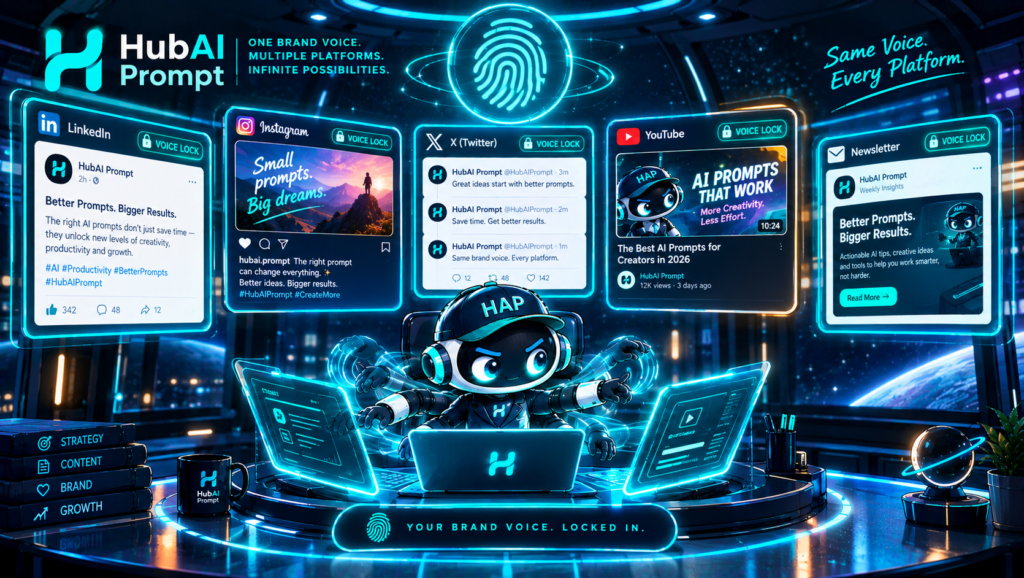
Voice drift often isn’t just post to post — it’s platform to platform. A brand can sound completely different on LinkedIn than on Instagram, not because the tone should change that much, but because each platform gets a different, disconnected prompt.
Use one core voice reference and example set across every platform, then adjust only what the platform actually requires — length, format, hashtag use. The tone underneath should stay the same even when the format changes on top of it.
This is also where a repeatable prompt structure matters more than people expect. If your LinkedIn prompt and your Instagram prompt share the same voice foundation, the brand sounds consistent even when the posts look nothing alike.
Turning This Into a System You Don’t Rebuild Every Week
Assembling a voice reference and example set once is easy. Remembering to paste all of it into every single caption prompt, every week, is where most people quietly stop bothering — and that’s exactly when the drift creeps back in.
JSON Prompt Mastery for Claude includes structured prompts built to carry context like this consistently, so your brand voice reference and examples are part of the repeatable structure instead of something you have to remember to attach every time.
If you’re producing a full month of social content at once, Batch Content Creation With AI covers how to run an entire batch through one consistent voice setup instead of drifting post by post across a session.
Edit for the Habits That Make Your Brand Sound Like You
Even with a strong voice reference, run a final pass on anything AI produces before it goes live. Look specifically for the small habits that make your brand recognizable — how you use emoji, whether you ever use exclamation points, the specific way you open or close a post.
These are the details a model tends to smooth over even with good examples, because they’re the most idiosyncratic part of a voice and the easiest to average out. A thirty-second edit pass for these habits does more for consistency than another round of prompt tweaking.
Signs Your AI Captions Have Drifted Off-Brand
A few warning signs are worth checking your recent posts against directly, since drift tends to happen gradually enough that it’s easy to miss from the inside.
Every caption sounds equally polished. Real brand voices have texture — some posts are punchier, some more reflective. If everything reads at the exact same register, that’s a sign the model is running on autopilot rather than your actual voice.
Comments start asking if something changed. Followers notice drift before you do, often. A pattern of “this doesn’t sound like you” comments is a direct signal worth taking seriously.
You keep editing the same things every time. If every AI draft needs the same fix — too formal, missing your usual humor, wrong sentence rhythm — that’s not an editing problem. It means the voice reference feeding the prompt isn’t strong enough yet.
Sounding Like Your Brand, Not Like Every Brand
AI doesn’t erase brand voice on its own. It just has nothing to work with unless you give it something — a clear reference, real examples, and a consistent structure across every platform and every post.
Build that once, keep it updated, and the gap between “AI wrote this” and “this sounds exactly like us” mostly disappears.
If sales and conversion copy is part of your content mix too, How to Write a Sales Page With AI Without It Sounding Fake covers the same specificity problem applied to pages built to convert rather than engage — and JSON Prompt Mastery for Claude is built to carry your voice consistently across both.
For more on documenting a brand voice AI can actually work from, Vista Social’s guide on AI brand voice is a solid external reference if you want a second source alongside the product link. Same note as the others — worth confirming the batch-content and sales-page slugs are live before this goes out.